ReasonScape
ReasonScape is a research platform for investigating how reasoning-tuned language models process information.
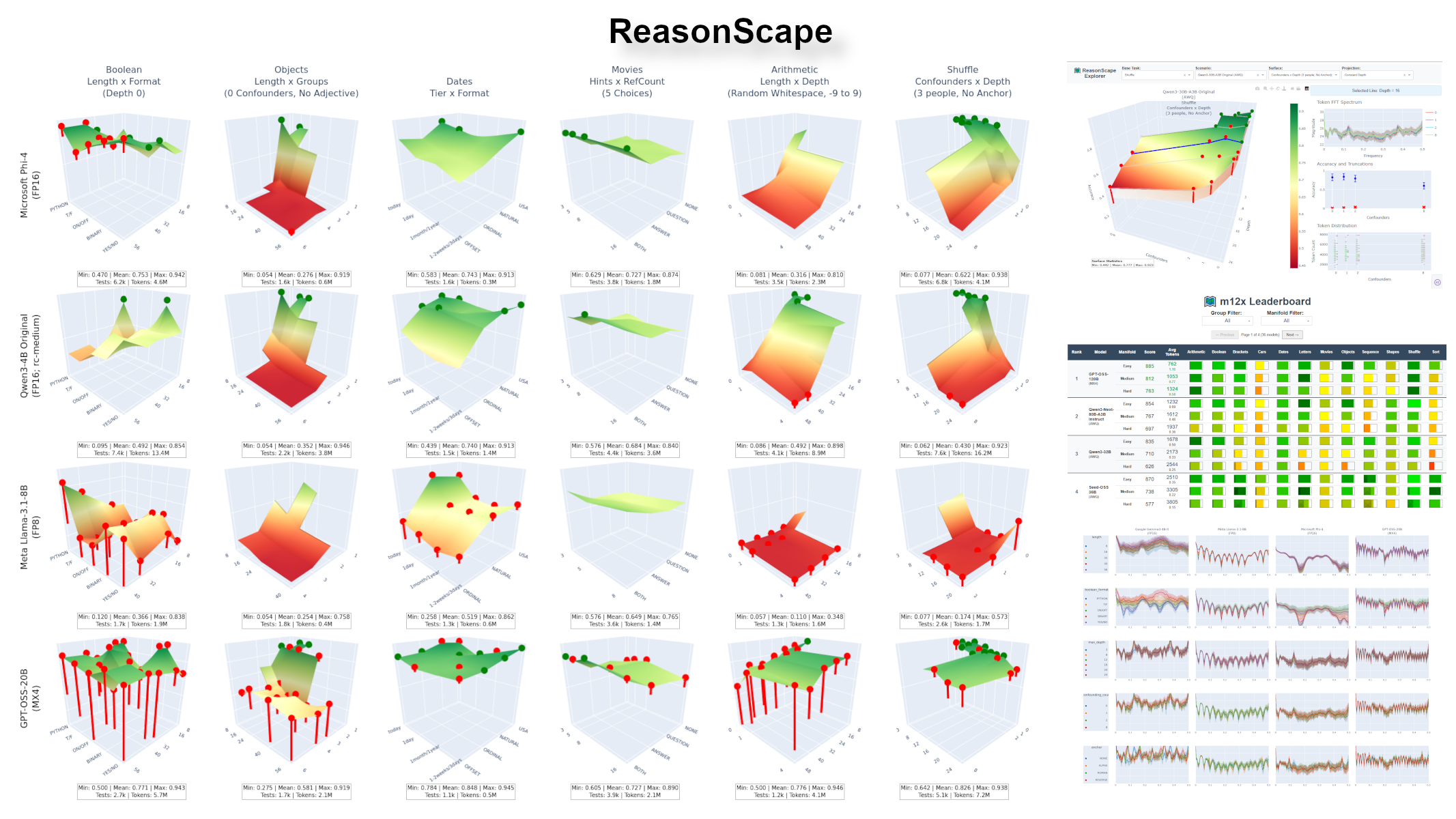
ReasonScape reveals cognitive architecture patterns invisible to traditional benchmarks: 3D reasoning landscapes (left), token-frequency spectral analysis (bottom right), and interactive exploration tools (top and middle right) enable systematic comparison of information processing capabilities across models and tasks.
🌐 Homepage: https://reasonscape.com/
🛠️ GitHub: the-crypt-keeper/reasonscape
Keywords: Large language models, AI evaluation, cognitive architectures, spectral analysis, statistical methodology, parametric testing, difficulty manifolds, information processing
Live Tools & Data
📊 Visualization Tools:
-
r12 Leaderboard: https://reasonscape.com/r12/leaderboard
-
r12 Explorer: https://reasonscape.com/r12/explorer (PC required)
📁 Raw Data:
- r12 Dataset: Download Guide | Direct Access (100+ models, 9B+ tokens)
ReasonScape V3
The ReasonScape documentation is organized into six chapters:
| Chapter | What It Is | Where to Learn More | |
|---|---|---|---|
| 1 | Challenges | Practical problems encountered in prior LLM evaluation systems | challenges.md |
| 2 | Insight | LLMs are not simply text generators, they're information processors | insight.md |
| 3 | Methodology | Systematic solutions that emerge from applying the Insight to the Challenges | architecture.md |
| 4 | Implementation | The Python codebase that makes it real | implementation.md |
| 5 | Reference Evaluation | r12 as the current reference evaluation | r12.md |
| 6 | Research Datasets | Worked examples showing the methodology in action | datasets.md |
Where to Start
Understand the Vision
Challenges - The problem statement (chapter 1)
- Fundamental challenges in current LLM evaluation
- Practical barriers encountered in prior systems
Insight - The paradigm shift (chapter 2)
- LLMs as information processors
- System architecture and transformation pipeline
Architecture - The methodology (chapter 3)
- Applies the Insight to the Challeneges
- Five-stage data processing pipeline
- Discovery-investigation research loop
Use the Datasets
r12 - The current reference evaluation (chapter 5)
- 12 reasoning tasks, 16k context
- ReasonScore v2 with bootstrap confidence intervals
Datasets - Research collections (chapter 6)
- Worked examples of complete investigations
- Templates for your own research
Workflow Guide - The Three P's
- Position: Ranking models ("Which is better?")
- Profile: Characterizing and diagnosing capabilities ("What can it do? Why does this fail?")
- Probe: Examining raw traces ("What does failure look like?")
Dive Deeper
Implementation - The Python codebase (chapter 4)
- Stage-by-stage implementation guide
- Deep-dive design documents (manifold, reasonscore)
- Tool references and workflows
Technical Details - Low-level algorithms
- Parametric test generation
- Statistical methodology
- FFT analysis and compression
Tools - Complete command reference
- All flags and formats for every CLI tool and webapp
- Filter syntax, output formats, probe loop classifications
Config - Experiment configuration
- Precision levels and sampling strategies
- Tasks (list, grid, manifold modes)
Templates & Samplers - Execution configuration
- Prompting strategies (templates)
- Generation parameters (samplers)
PointsDB - Data structure API
Tasks - Abstract task API and task overview
Citation
If you use ReasonScape in your research, please cite:
@software{reasonscape2025,
  title={ReasonScape: Information Processing Evaluation for Large Language Models},
  author={Mikhail Ravkine},
  year={2025},
  url={https://github.com/the-crypt-keeper/reasonscape}
}
License
MIT
Acknowledgments
ReasonScape builds upon insights from BIG-Bench Hard, lm-evaluation-harness, and the broader AI evaluation community.